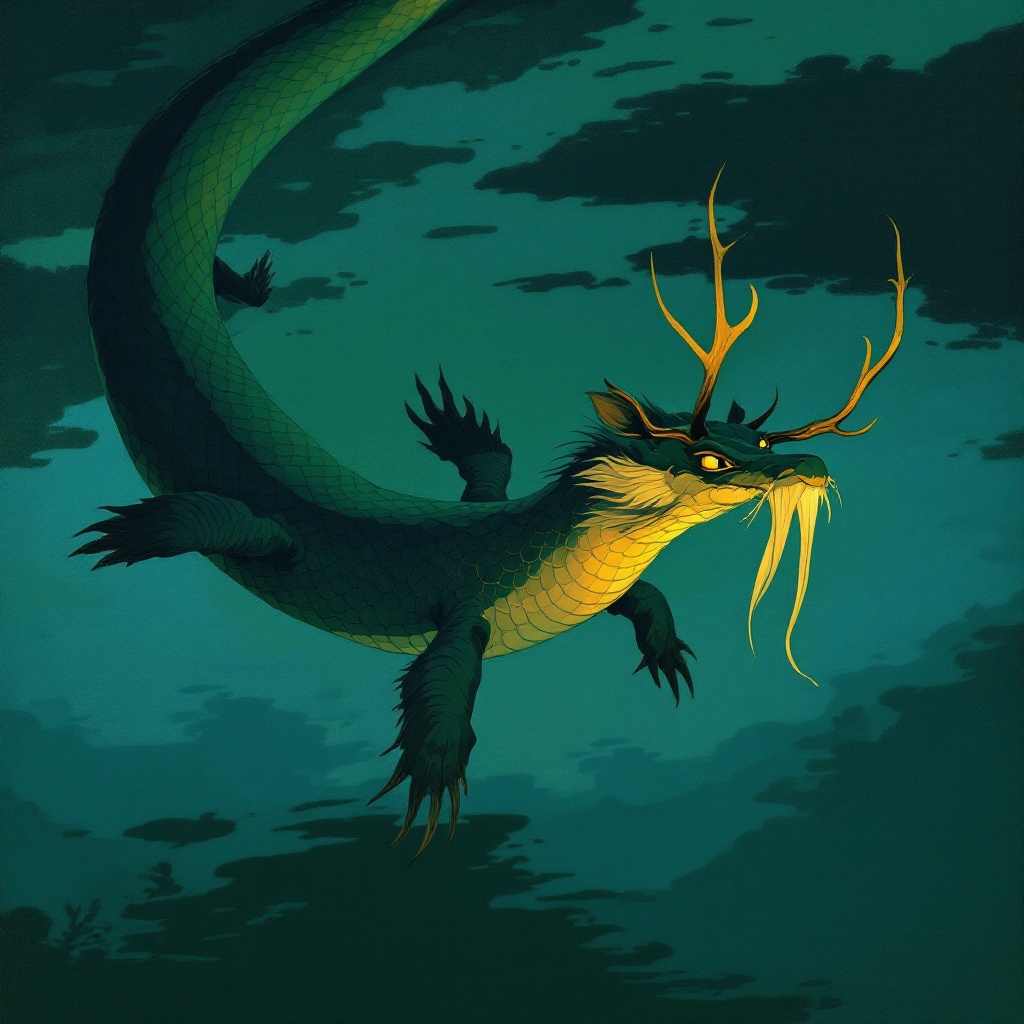
The Name
Every great guardian carries two names: the office and the soul. Hebo (河伯) is the office — hé (河), the river in its oldest and largest sense, and bó (伯), the first rank of the five noble titles, the Earl, the sovereign of a domain. Together they name a celestial post that appears in the oldest texts of the Chinese literary tradition: not a spirit lurking at the ford, but a titled officer of heaven, one who is petitioned, honored, and appeased by courts and kingdoms. The Earl of the River holds dominion over every current that moves through his assigned waters.
Joaquin is the soul — the specific river, his river, and in naming it he names himself. The San Joaquin was christened by Spanish missionaries in the Central Valley of California, a river named for San Joaquín: Saint Joachim, the father of the Virgin Mary in Catholic tradition, a patriarch of quiet faithfulness. The river bearing his name rises in the snowfields of the Sierra Nevada, widens through three hundred miles of valley floor, fans into a tidal delta of channels and tule marsh, and becomes navigable — deep enough for a real ship's keel — at the city of Stockton.
The grammar of the name is the grammar of a person given his seat: Joaquin tells you which river, Hebo tells you the rank he holds there. Seat and person together, each half cited to its own tradition, each half true.
Origin — Stockton, 1938
The story they tell aboard JADA begins at the Stephens Brothers yard in Stockton, California, in 1938. It was a long build. The keel was laid on white oak heartwood chosen for its resistance to the bilge-wet dark. Port Orford cedar made the frames. The hull planks were fitted by a caulker who drove the oakum tight enough that you could hold the seams to the light and see nothing pass. The launch day came, and a small crowd assembled on the bank of the river.
The story goes that the San Joaquin would not give her up without a mark.
As JADA began to move down the launch ways — greased, singing, gathering momentum — the water itself rose differently than water rises. There was a shape under the surface, long and coiling, the color of the deep delta channel where the tule sediment settles out and the water goes the green of old glass. It ran the full length of the hull, moving with the hull, not against it. It was gone before anyone present could agree on what they had seen. And then JADA was in the water and the San Joaquin was simply the San Joaquin again, brown and brackish and entirely ordinary, doing what rivers do.
The Earl had made his attendance known. He had watched every timber chosen, had been present through every mallet-stroke of the caulking iron, had run through the grain of the wood the way river-water runs through the roots of the cottonwood trees on both banks. When the hull finally moved, he did not watch it leave. He moved with it.
The Taming
No one subdued Hebo Joaquin. The Earl is older than the family that built the boat, older than Stockton, older perhaps than the word river in any language spoken on that shore. To attempt taming by force would be as sensible as attempting to pin a current to a wall.
What the queen of JADA offered instead was kinship — and a particular kind of kinship that only she could offer.
Fresh water and salt water are in perpetual tension in the sailor's catechism. The river swells the wood, the salt shrinks it; the river nourishes what the salt eventually kills. Every sailor who has run a river-bar out into open water knows the exact moment when the two waters meet under the hull — the shudder, the change of smell, the slight shift in the boat's motion. It is a threshold, and thresholds are uneasy places.
The queen of JADA is herself a threshold. She is the vessel that carries river-born passengers out to sea and brings sea-worn travelers back to port. She holds both waters in her planking simultaneously, always at the between. And the story says that on the day JADA first left Stockton for the open coast, the river-lord placed a ribbon of San Joaquin water in her hair — not a curse, not a chain, but a mark of belonging, the way a father marks a child going a long way from home. Some part of JADA would always carry the river's water in her. The Earl, tasting his own water when he found her again in San Diego Bay, recognized his kin. He stopped grieving the departure and became instead what he had always been suited to be: the guardian who knows exactly where the door is, because the door is his.
The Power
The ChannelHebo Joaquin's gift to JADA is the channel — the deep-water line through every bar and shoal and river-mouth in the waters she has ever touched. The Sacramento bar. The Carquinez Strait. The turning basin at Stockton. The kelp-draped edges of San Diego Bay's inlet. Every entrance and exit JADA has used in her roughly twenty years on San Diego Bay, the Earl has memorized not as a chart memorizes it — a fixed line drawn once and growing outdated — but as the river memorizes the bottom: continuously, the way water learns what is under it.
A bar that was eight feet of water in June is three feet in September. A channel that let the deep-keeled yawl pass outward on the morning flood may have shifted sand by the time she turns for home on the ebb. The pilot's chart is always a month behind the river's truth. The Earl is not. When JADA's keel is moving toward ground, his antlers come forward and the long delta-reed whiskers fan out across the hull's underwater run, and every line in the rigging hums a single low note of warning — the same note, always the same note — and the helmsman who has learned to listen finds deep water before the keel finds sand. Sailors who come aboard JADA tend to stop running aground. They seldom know precisely why.
He knows wood the way rivers know roots: from the inside. The river is always in the timber that grew on its banks, and the Earl is always in the timber that floated on his water. On the morning watch, when the boat is quiet and the crew is between shifts, you can sometimes hear it — one careful tap, muffled and precise, somewhere deep in the bilge. Not the hull working in a swell. Not settling. A tap with intent, locating the seam that the caulker hasn't reached yet. By the time the carpenter finds it, the oakum is already tight.
For the guests who sail aboard JADA, the gift is simpler to name: they feel at ease on the water in a way they do not always expect. The boat moves as though she knows exactly where she is going. She does.
The Scholarship
Hebo Joaquin's form follows the classical lung as documented in the Later Han dynasty. Wang Fu, writing in the Qianfulun (潛夫論, Discussions of the Recluse, compiled roughly the first and second centuries CE), gave the lung nine resemblances: the head of a camel, the horns of a stag, the eyes of a demon, the ears of a cow, the neck of a snake, the scales of a carp, the claws of an eagle, the soles of a tiger, and the long whiskers of a river-fish. The image that propagates through two thousand years of Chinese art, textile, and story follows Wang Fu closely enough that its variations are scholarly footnotes rather than contradictions.
Hebo Joaquin is Wang Fu's lung adapted to the Sacramento-San Joaquin delta: the stag antlers are ridged with river-moss; the whiskers fan long and pale as the delta-reed grass at the river's mouth; the carp scales carry the specific iridescence of a Central Valley carp under spring flood-light; the eagle claws are suited to gripping oak planking from below without leaving a mark. He does not fly. He flows. The river-lung is wingless not from diminishment but from purpose — a creature of current does not need to leave the water.
The office of 河伯 is documented in the Chuci (楚辭, Songs of the South), texts attributed to the Chu court poet Qu Yuan and the tradition surrounding him, third century BCE. The hymn titled Hebo — "Lord of the River" in David Hawkes's translation — describes the Earl riding a dragon carriage across the river's face, robed in lotus leaves, girdled with iris, traveling to the meeting of the nine streams. Hawkes's complete scholarly translation, published by Penguin Books in 1985 as The Songs of the South: An Ancient Chinese Anthology of Poems by Qu Yuan and Other Poets, remains the standard English edition and the source from which the lore of this name draws.
"With lotus leaves for coat and fig-tree for flag, / driving swiftly, swiftly, across the wide river."
The Chuci is a fact of Chinese literary history. Wang Fu is a fact of Chinese philosophical history. The caulking tap in JADA's bilge is legend. The distinction is the whole point.
The Guard
Hebo Joaquin is one of six who hold the ship. Each was bonded to a different era of JADA's life and guards a different face of the sea. Together they form the Dragon Bodyguards of JADA — a lore that the crew has been adding to, quietly, for as long as the boat has been sailing.